Alcohol Testing Requirements in South Africa: What Producers Must Test and Record
Testing obligations reach South African alcohol producers from three directions at once: product legislation that sets composition standards, excise law that taxes you on measured alcohol content, and export markets with their own certification demands. None of it is exotic laboratory science — but all of it must be measured consistently and recorded durably, and that second half is where producers get caught.
The Three Sources of Testing Obligations
1. The Liquor Products Act and composition standards
The Liquor Products Act (Act 60 of 1989) and its regulations define what may legally be called wine, spirits, beer, or other liquor products, and set composition requirements — permitted additives, limits on parameters like volatile acidity and sulphur dioxide in wine, and minimum alcohol strengths for defined spirit categories. The Act is administered by the Department of Agriculture, and wine destined for export is certified through the Wine and Spirit Board. If your product does not meet its category's composition standard, it may not be sold under that name.
2. Excise: strength as a tax measurement
Spirits duty is levied per litre of absolute alcohol, which makes every ABV measurement a tax declaration. SARS expects strength to be measured with calibrated instruments and recorded per batch — a casual hydrometer reading rounded to the nearest half percent is an audit finding waiting to happen. Our excise audit checklist covers how these records get examined.
3. Labelling and safety
The alcohol strength on your label must be accurate within regulated tolerances, allergen and additive rules apply, and basic safety parameters — most seriously methanol in distilled spirits — are the producer's responsibility to control. Methanol testing is not bureaucratic box-ticking; it is the test that keeps people safe and producers out of the news.
What a Sensible Testing Programme Looks Like
- Every batch: ABV at defined stages (fermentation end, post-distillation, pre-bottling), plus the parameters that define your product — pH, TA, SO2 for wine and cider; gravity for beer.
- Per production run of spirits: methanol and congener checks appropriate to your process, especially with fruit-based ferments.
- Periodically: water quality, packaged-product shelf checks, and calibration of the instruments doing all of the above.
- On demand: export certification testing through accredited labs when markets require it.
For the fuller quality picture — sensory panels, micro checks, and consistency tracking — see our guides to lab testing and quality assurance and alcohol quality testing.
The Record Is Half the Requirement
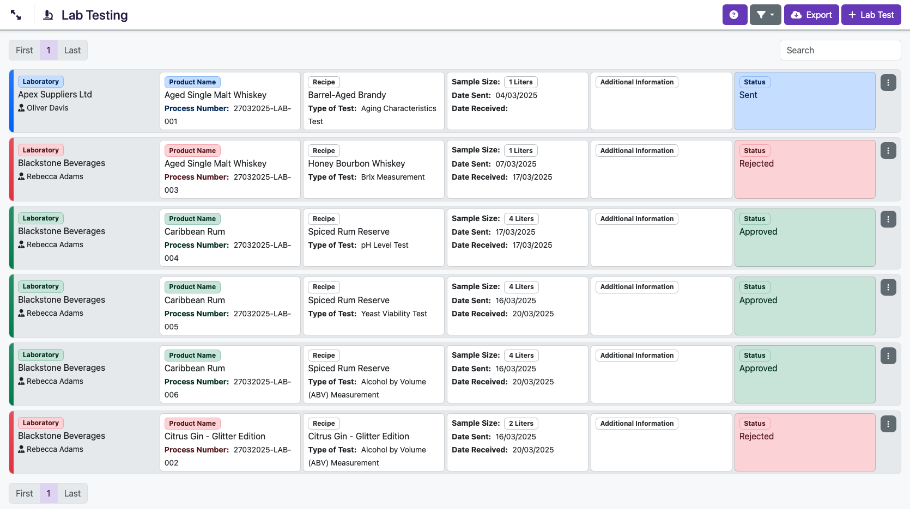
A test that is not recorded might as well not have happened: inspectors, auditors, and export certifiers all evaluate your records, not your memory. Results belong against the batch — dated, attributed, with the instrument and method noted — so any bottle can be traced back to its numbers. This is exactly what Liquor Logic's lab testing and batch tracking does: results captured against the batch during normal work, approvals logged, and history comparable across vintages and recipes. It also closes the compliance loop described in our South African compliance guide.
Frequently Asked Questions
Do small craft producers have to do laboratory testing?
The obligations scale with what you make, not how much of it. A nano-distillery's spirit carries the same methanol responsibility and excise strength requirements as a large one's. What scales is the equipment — small producers combine in-house instruments for routine parameters with accredited labs for periodic verification.
How accurate does label ABV need to be?
Regulated tolerances apply per product class (of the order of half a percentage point for most products). The practical standard is tighter: measure well, label what you measured, and keep the measurement record.
What instruments does a small producer actually need?
A calibrated alcohol hydrometer or density meter, pH meter, and thermometer cover the routine core for most producers; wine and cider add SO2 and TA titration. Buy calibration standards with the instruments — an uncalibrated instrument produces confident fiction.
Conclusion
Testing requirements look daunting listed together, but they reduce to a rhythm: test the defined parameters at the defined stages, record every result against the batch, and calibrate what you measure with. Put that rhythm in software and compliance becomes a report. Book a demo to see batch-linked lab records in Liquor Logic.