Alcohol Quality Testing: Everything Producers Need to Know
In the alcohol industry, quality is not a marketing promise—it's a production discipline. Every pint poured, every bottle uncorked, and every dram served is a direct reflection of the alcohol quality testing processes that ran behind the scenes. For breweries, distilleries, and wineries, quality assurance is the systematic process of verifying that raw materials, work-in-progress batches, and finished products meet the standards your brand, your customers, and your regulators expect.
This guide covers the full scope of alcohol quality testing: what it involves, why it matters, the key tests producers should run at every stage of production, and how modern production management software makes quality assurance a seamless part of your workflow—not a separate administrative burden.
Why Alcohol Quality Testing Matters
Quality failures in alcohol production are expensive in every sense. A contaminated batch means lost raw materials, wasted labour, occupied tanks, and missed revenue. But the damage doesn't stop at the batch level. A quality failure that reaches the customer—an off-flavour in a flagship beer, a cloudy wine, a poorly balanced spirit—damages your brand in ways that are far harder to quantify and far slower to recover from.
Beyond customer satisfaction, quality testing in alcohol production serves critical regulatory and safety functions. Accurate ABV measurement is required for excise duty compliance. Testing for contaminants and harmful compounds—particularly methanol in spirits—is a non-negotiable safety requirement. Traceability through quality records allows producers to isolate and recall specific batches quickly if a problem is identified post-distribution. For craft producers, where brand identity is tightly linked to product consistency, a robust QC process is not optional—it's a core business function.
The Three Stages of Alcohol Quality Testing
Effective beverage quality management is built on testing at multiple stages: incoming raw materials, during production, and on finished goods before release. Confining quality checks to the end of the production process is too late to save a compromised batch.
Stage 1: Raw Material Testing
The quality of your final product begins with the quality of your inputs. Before raw materials enter production, they should be tested or verified against supplier specifications.
- For breweries: Malt should be assessed for moisture content, extract yield, and colour. Hops should be checked for alpha acid content and freshness—degraded hops produce flat, poorly bittered beer. Yeast should be assessed for viability and cell count before pitching.
- For distilleries: Grain bills should be tested for moisture and potential starch content. Water quality—mineral profile, pH, hardness—is critical and often overlooked.
- For wineries: Incoming grapes should be assessed for Brix (sugar content), pH, and titratable acidity before crush.
Documenting raw material test results and linking them to batch records creates a traceable quality chain from supplier to finished product—invaluable when investigating quality issues or managing supplier relationships.
Stage 2: In-Process Quality Testing
In-process alcohol quality testing monitors batch progress at key production milestones. These tests allow producers to catch issues while they're still correctable, rather than discovering them at packaging or after release. Key in-process tests for breweries include:
- Original Gravity (OG): Measured at the start of fermentation to confirm the wort's fermentable sugar content matches the recipe. Deviations indicate mashing or sparging issues.
- pH Monitoring: Wort pH affects enzyme activity and yeast health. Target ranges vary by style but typically sit between 5.2 and 5.4 during mashing.
- Fermentation Temperature: Temperature excursions produce off-flavours—esters, fusel alcohols, and diacetyl—that may be difficult to remediate.
- Apparent Attenuation: Tracking gravity readings through fermentation confirms that yeast is performing as expected. Stalled fermentations need early intervention.
- Diacetyl Testing: Diacetyl (a butterscotch off-flavour) is a common fermentation byproduct. Testing before conditioning confirms whether sufficient conditioning time is required.
For distilleries, in-process testing focuses on cut points during distillation, spirit strength at various stages, and congener analysis. For wineries, monitoring fermentation temperature, Brix depletion, and volatile acidity during fermentation is standard practice.
Stage 3: Finished Product Testing
Before a product is packaged and released, it must pass a final quality gate. Finished product quality testing for alcohol producers typically includes:
- Alcohol By Volume (ABV): Accurate ABV measurement is required for labelling compliance and excise duty calculation. Digital density meters and ebulliometers are common tools.
- Colour and Turbidity: Visual and instrument-based assessment of colour and clarity. Turbidity meters provide objective measurement for styles where clarity is expected.
- Sensory Evaluation: Trained tasting panels assess aroma, flavour, mouthfeel, and finish against a defined style profile. Sensory evaluation remains one of the most important quality tools despite—and alongside—analytical testing.
- Microbiological Testing: Checks for wild yeast, bacteria, and mould that could cause spoilage or safety issues. Particularly important for products with extended shelf life or wide distribution.
- Dissolved Oxygen (DO): Oxygen pickup during packaging accelerates staling in beer. DO meters are standard in modern brewing quality programmes.
- Packaging Integrity: Fill levels, seal integrity, carbonation levels, and label accuracy all form part of the finished goods quality check before release.
Building a Quality Assurance Programme
A quality assurance (QA) programme formalises the testing processes above into a structured, documented system. Effective craft beer quality assurance and spirits QA programmes share common foundations:
- Standard Operating Procedures (SOPs): Written procedures for every testing method, including sample collection protocols, equipment calibration requirements, acceptable ranges, and escalation procedures for out-of-spec results.
- Critical Control Points (CCPs): Drawing from food safety methodology, identifying the production points where a quality or safety failure could have the greatest impact—and establishing controls and testing protocols at those points.
- Calibration and Maintenance Schedules: All testing equipment—pH meters, hydrometers, turbidity meters, DO meters—must be regularly calibrated against certified standards. Uncalibrated equipment produces unreliable data.
- Trend Analysis: Monitoring quality metrics over time reveals systematic issues—a supplier whose malt quality is declining, a fermentation vessel that consistently runs warm, a packaging line introducing oxygen pickup.
- Non-Conformance Management: A defined process for managing batches or finished goods that fail QC checks: hold procedures, investigation protocols, remediation options, and, where necessary, safe disposal.
Common Alcohol Quality Testing Mistakes to Avoid
Even experienced producers fall into patterns that undermine the effectiveness of their quality programmes. Watch out for these common pitfalls in brewery QC processes and alcohol quality management:
- Testing at the end only: End-of-production testing is too late to save a compromised batch. Integrate testing throughout the production process at defined milestones.
- Inconsistent sampling: Results are only meaningful if sampling is consistent. Standardise where and how samples are taken for every test, and document the protocol in your SOPs.
- Poorly maintained equipment: A pH meter with a clogged reference junction or an uncalibrated hydrometer produces misleading results that erode confidence in your entire QC programme.
- No written procedures: Verbal QC routines are fragile. They don't survive staff turnover and they can't be audited. Document everything.
- Skipping sensory evaluation: Analytical tests don't catch everything. Regular, structured sensory evaluation by trained staff remains a cornerstone of effective quality assurance.
How Liquor Logic Supports Alcohol Quality Testing
Managing quality data across disconnected spreadsheets and paper logs is one of the most common weaknesses in smaller alcohol production operations. Test results get recorded but never systematically reviewed. Batch records and QC data live in different places, making root cause analysis difficult. Liquor Logic addresses this by integrating quality control directly into the production workflow.
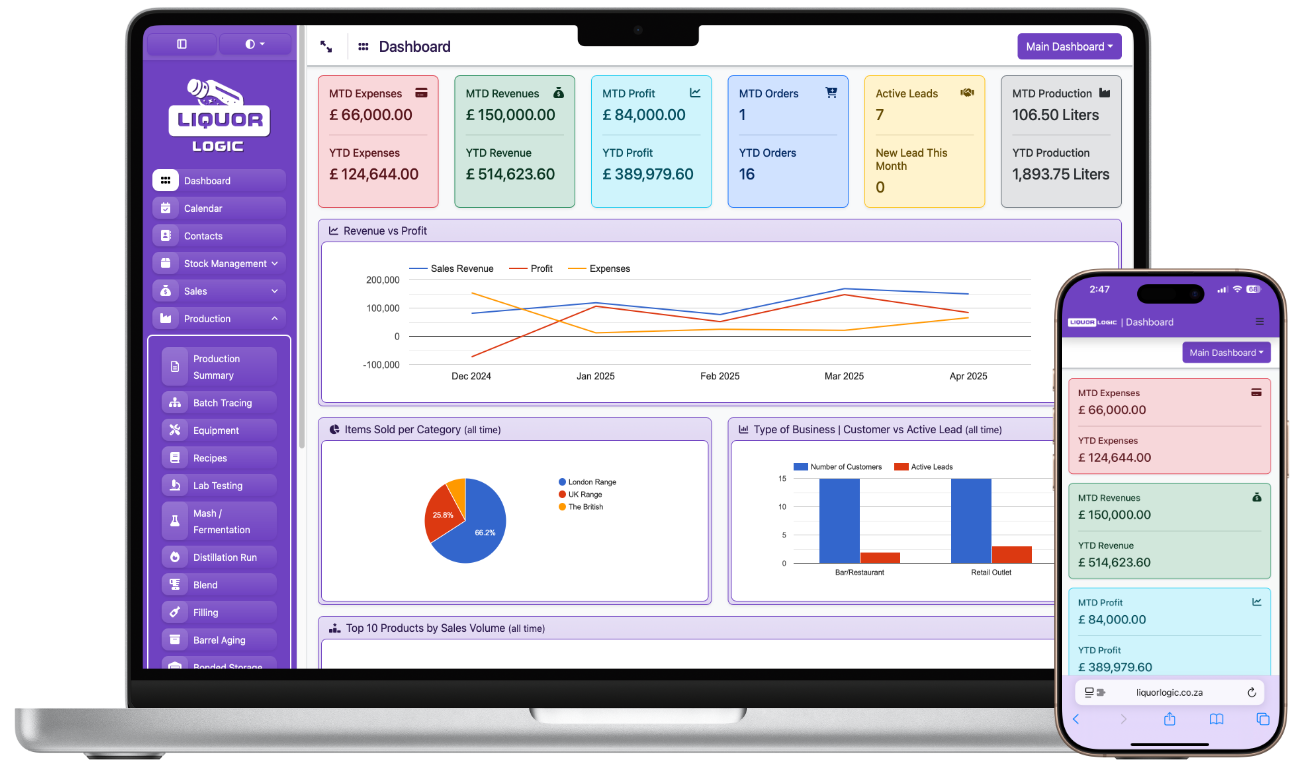
Quality checkpoints are built into Liquor Logic's batch management process, prompting staff to record test results at the right production stage. All QC data is stored against the batch record, creating a complete, searchable quality history for every product. Real-time dashboards let production managers see which batches have passed all QC gates and which are pending results. Automated alerts flag batches where recorded parameters are approaching out-of-spec thresholds—enabling early intervention rather than late-stage remediation. For compliance purposes, Liquor Logic's batch and quality records provide the documentation trail regulators expect, without the manual effort of compiling reports from disparate sources.
Get Started with Liquor Logic
Liquor Logic helps breweries, distilleries, and wineries build quality into every stage of production—not as an afterthought, but as an integrated part of how you brew, distil, and ferment. From raw material intake to finished product release, our platform gives you the tools to maintain consistency, meet compliance requirements, and protect the reputation you've worked hard to build.