What Is a Bonded Warehouse? A Practical Guide for South African Alcohol Producers
Excise duty on spirits is substantial — often rivalling or exceeding production cost. If producers had to pay it the moment product came off the still, maturation businesses could not exist: nobody can prepay duty on whisky that sells in five years. The bonded warehouse is the mechanism that makes the industry workable: a licensed space where excisable product is held with duty suspended until it leaves for the market.
How Duty Suspension Works
A customs and excise warehouse (licensed by SARS) lets you manufacture and store excisable goods "in bond" — the duty liability exists but is not yet payable. Duty crystallises when product is removed from bond for home consumption: entered into your excise account, declared on the return, and paid on the declared litres of absolute alcohol. Product moving between licensed warehouses, or exported, moves under bond without triggering duty — with the movement documents to prove it.
The commercial effect is cash flow: a distillery filling barrels pays duty per bottle as bottles sell, years later, not per barrel at fill. For any producer holding maturing stock, the bonded warehouse is not admin — it is the balance sheet.
What the Licence Obliges You to Do
- Account for everything: a running excise account reconciling receipts, removals, losses, and closing stock — the warehouse's stock ledger in tax form. See our excise reporting guide for how the returns work.
- Keep bonded and duty-paid stock separated — physically and in your records. Mixed storage with no systematic separation is the single most common audit finding; our excise audit checklist ranks the others.
- Document losses as they occur: maturation evaporation, processing losses, and breakages are legitimate in bond — if recorded at the time. Undocumented shortfalls are assessed as if you removed the product and sold it.
- Move stock on paper as well as in trucks: transfers between warehouses need corresponding documentation on both ends.
- Retain records for the statutory period and produce them on request.
Bonded vs Duty-Paid: The Everyday Discipline
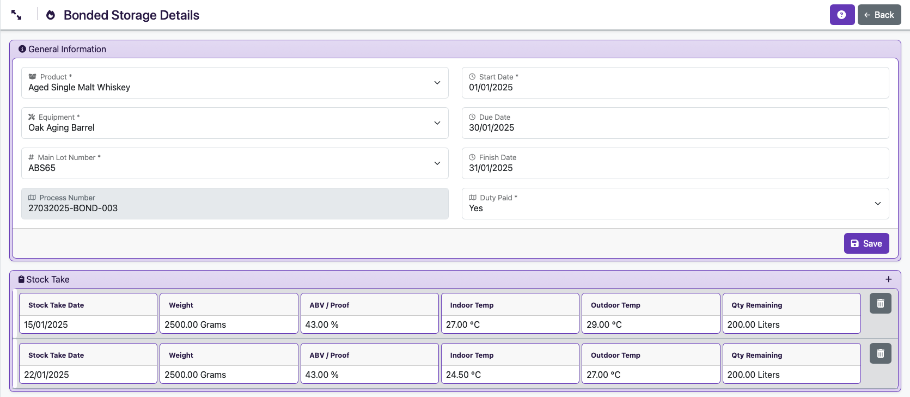
Day to day, the licence reduces to one discipline: at any moment, for any product, you must know whether it is bonded or duty-paid, where it is, and how it got there. The producers who struggle are the ones tracking this in heads and spreadsheets across a growing operation — tasting room stock drawn casually from bond, samples unrecorded, transfers half-documented. The producers who do not struggle run it in software: Liquor Logic tracks bonded storage as distinct locations, makes removal from bond an explicit logged transaction, records losses against batches, and keeps the excise account permanently reconciled to physical stock.
Frequently Asked Questions
Do I need a bonded warehouse to produce alcohol in South Africa?
To manufacture excisable product, your premises must be licensed with SARS as a customs and excise manufacturing warehouse — it is part of manufacturer registration, alongside your liquor authority licensing.
Can my tasting room pour bonded stock?
No — product consumed or sold at retail must first be removed from bond, declared, and duty paid. The clean pattern is a recorded transfer from the bonded location to a duty-paid location, matched in your excise account. Casual "borrowing" from bond is how tasting rooms create audit findings.
What happens to duty on maturation losses (the angel's share)?
Documented, reasonable losses in bond are written off without duty. The operative word is documented: record evaporation per cask from regauging, and the angel drinks tax-free; fail to record it, and SARS assumes you drank it — at your expense.
Conclusion
The bonded warehouse is the most valuable licence your production business holds — it finances your maturation and your cash flow. Keeping it healthy is a records discipline, and the discipline is far easier when the system enforces it. Book a demo to see bonded stock, removals, and the excise account working as one in Liquor Logic.