Alcohol Production Management: A Complete Guide for Modern Producers
Master alcohol production management to streamline every stage of your brewing, distilling, or winemaking operation—from raw ingredient sourcing to finished product dispatch. Discover how Liquor Logic's purpose-built platform gives craft producers and large-scale manufacturers the visibility, control, and compliance confidence they need to operate at their best.
What Is Alcohol Production Management?
Alcohol production management is the process of planning, executing, monitoring, and optimising every stage of alcohol manufacturing. It bridges the gap between procurement and sales, ensuring raw materials arrive on time, batches are scheduled efficiently, finished goods meet quality standards, and records satisfy regulators.
For a brewery, this means managing malt, hops, yeast, and water through mashing, fermentation, conditioning, and packaging. For a distillery, it involves grain bills, distillation runs, barrel ageing, and bottling. For a winery, it covers grape intake, crush, fermentation, barrel programmes, and blending. Each operation has its own rhythms and challenges—but all share a common need for tight operational control. Without a structured approach, even experienced producers find themselves firefighting: scrambling to cover ingredient shortages, losing track of batch progress, or missing compliance deadlines.
Key Areas of Alcohol Production Management
Effective beverage production management spans several interconnected disciplines. Here's what every producer needs to have under control:
- Production Planning and Scheduling: Forecasting demand, scheduling batch runs around facility capacity, and ensuring raw materials are available when needed. Poor scheduling leads to idle tanks, rushed batches, and missed sales windows—all of which eat directly into margins.
- Raw Material Management: Tracking quantities on hand, monitoring expiry dates, managing supplier lead times, and ensuring proper storage conditions. Hops lose alpha acids over time. Yeast viability diminishes. Grain absorbs moisture if not stored correctly.
- Batch and Recipe Management: Ensuring consistency across every batch—the same malt-to-hop ratios, the same fermentation temperatures, the same conditioning durations. Scaling recipes up or down, or tweaking for seasonal releases, introduces complexity that spreadsheets handle poorly.
- Quality Control: Integrating QC checkpoints directly into the production workflow so test results are captured against batch records—making it easy to trace quality issues back to specific ingredients, suppliers, or process steps.
- Regulatory Compliance: Excise duty reporting, production volumes, raw material consumption, and product movement all require meticulous documentation. Automated compliance reporting pulls data directly from batch records to generate accurate returns with minimal manual effort.
Challenges in Alcohol Production Management
Producers across the alcohol industry face a common set of operational challenges that generic manufacturing tools are not equipped to handle. Tracking raw materials in alcohol production is a prime example—ingredients have varying shelf lives, require specific storage conditions, and must be carefully rotated to prevent spoilage and ensure batch consistency.
Batch tracing is another significant hurdle. Every recipe is unique, and linking finished products back to their specific ingredient sources is critical for both quality investigations and regulatory compliance. Recipe costing adds further complexity, as fluctuating ingredient prices make it difficult to predict and protect margins. And stock rotation—using FIFO (First In, First Out) or FEFO (First Expired, First Out)—is essential but nearly impossible to enforce systematically without automation.
Disconnected Systems and Data Silos
One of the most common pain points in alcohol manufacturing is operating with multiple disconnected tools—one system for inventory, another for sales orders, a spreadsheet for production scheduling, and a separate template for compliance reporting. The manual effort of keeping these in sync is enormous, and errors are inevitable when data is transcribed between systems. A unified alcohol production management platform eliminates these silos, giving every team member access to the same real-time data.
Scaling Complexity
Growth is the goal, but scaling an alcohol production operation introduces layers of complexity. More SKUs, more fermentation vessels, more staff, more sales channels—all of these multiply the variables your production management process must handle. Systems that worked at small scale quickly become bottlenecks. A purpose-built brewery ERP system or distillery management platform scales with your business, ensuring operations remain efficient as you grow.
Strategies for Effective Alcohol Production Management
To overcome these challenges, alcohol producers can adopt proven strategies—powered by tools like Liquor Logic. Here's how to build a more resilient, efficient operation:
- Implement Purpose-Built Production Software: Specialised alcohol production management software provides real-time visibility into every production stage, connects procurement to scheduling, and generates compliance reports automatically. Generic ERP tools require costly customisation; brewery- and distillery-specific platforms are ready to use from day one.
- Standardise Your Recipes: Document every recipe in full detail, including ingredient specifications, process parameters, and quality benchmarks. Standardisation is the foundation of consistency, and consistency is what builds brand loyalty and protects margins.
- Enforce FIFO and FEFO Rotation: Use First In, First Out (FIFO) for general stock rotation and First Expired, First Out (FEFO) for perishable ingredients. Automated alerts within your production system make this seamless.
- Integrate Production with Sales Data: Connect your production schedule to your sales forecasts and POS data so batch volumes are aligned with actual market demand—preventing overproduction of slow-moving lines and stockouts of your bestsellers.
- Review Production KPIs Regularly: Track metrics including batch yield, ingredient variance, waste percentage, and compliance accuracy. Consistent KPI reviews drive continuous improvement and surface issues before they become costly.
How Technology Is Transforming Alcohol Production Management
The rise of cloud-based, mobile-friendly beverage operations management platforms has fundamentally changed what's possible for independent producers. Where enterprise-grade ERP systems were once the exclusive domain of large-scale manufacturers, solutions like Liquor Logic bring that same level of operational control to craft breweries, boutique distilleries, and independent wineries.
Key capabilities that modern alcohol production management software delivers include:
- End-to-End Traceability: Link every finished product back to the specific batch, specific ingredients, and specific supplier—critical for quality assurance and regulatory compliance.
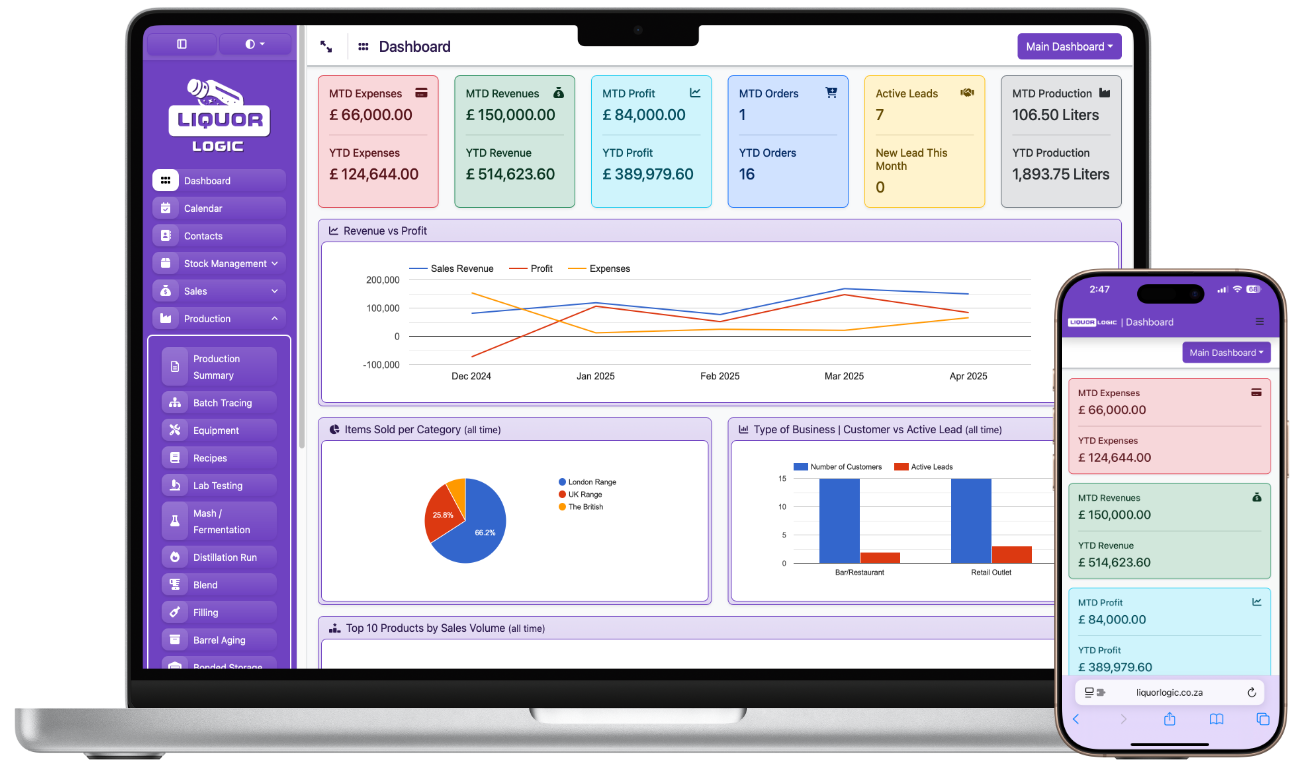
- Real-Time Production Dashboards: See exactly where every batch is in the production cycle, which tanks are occupied, and what's scheduled next—from any device, anywhere.
- Integrated Inventory Management: Synchronise raw material consumption with production progress so inventory records update automatically as batches move through the system.
- Demand-Driven Scheduling: Connect your production calendar to your sales data so production volumes are aligned with actual market demand rather than gut feel.
- Automated Compliance Reporting: Generate excise duty returns, production reports, and traceability records directly from your batch data—eliminating manual transcription and reducing compliance risk.
Benefits of Effective Alcohol Production Management
Investing in a robust alcohol production management system yields significant operational and financial returns. Here's what producers consistently report after making the switch:
- Reduced Waste: Proactive monitoring of ingredient expiry and batch progress prevents costly spoilage events and off-spec batches from reaching the packaging stage.
- Improved Cash Flow: Demand-aligned production planning and optimised raw material purchasing free up capital that was previously tied up in excess stock.
- Increased Efficiency: Automating manual tasks—stock counts, batch logging, compliance reporting—redirects your team's time to brewing, distilling, and growing the business.
- Stronger Compliance Confidence: Accurate, auditable records maintained automatically by your production management system reduce the risk and stress of regulatory inspections.
- Enhanced Profitability: Minimising waste, preventing stockouts, and improving forecast accuracy all contribute directly to healthier margins.
Why Liquor Logic Is Built for Alcohol Production Management
Liquor Logic was designed from the ground up for the alcohol production industry. Unlike generic manufacturing ERP systems that require costly customisation, Liquor Logic speaks the language of brewers, distillers, and winemakers—with features built around the specific workflows of alcohol production. Key capabilities include:
- Recipe Development and Production Tracking: Scale recipes accurately and monitor every stage of the production cycle with full batch traceability.
- Real-Time Raw Material Inventory: Track ingredient levels from goods receipt through to consumption, with automated reorder alerts and FEFO rotation support.
- Multi-Location Management: Manage stock and production data across taprooms, production facilities, and warehouses with real-time updates and consolidated reporting.
- Cloud-Based, Mobile-Friendly Access: Access your production data anywhere, anytime—on the production floor, in the cellar, or from anywhere in the world.
- Integrated Compliance Reporting: Generate excise returns and traceability records directly from operational data, with no manual compilation required.
Get Started with Liquor Logic
Stop managing your alcohol production across disconnected spreadsheets and whiteboards. Liquor Logic brings your entire operation—from raw material intake to finished goods dispatch—into one intelligent, cloud-based platform. Join breweries, distilleries, and wineries worldwide who are using Liquor Logic to operate more efficiently, more profitably, and with full regulatory confidence.