Alcohol Technology: How Innovative Software Is Reshaping the Brewing and Spirits Industry
The alcohol industry has always been steeped in tradition—and rightly so. Time-honoured recipes, generations of accumulated craft knowledge, and deeply held production philosophies are part of what makes great beer, whisky, and wine special. But tradition and technology are not in conflict. The most innovative breweries, distilleries, and wineries in the world are the ones combining craft expertise with modern alcohol technology—and pulling ahead of competitors who are still running on spreadsheets and gut feel.
This post explores the most impactful developments in brewing industry innovation today: what they are, what they enable, and how forward-thinking producers are using them to brew smarter, operate leaner, and grow faster.
The Shift from Manual to Digital in Alcohol Production
Not long ago, a typical craft brewery's operational infrastructure looked something like this: a whiteboard for production scheduling, a collection of notebooks for batch records, a series of spreadsheets for inventory tracking, and a separate accounting package for financial reporting. This worked—mostly—at very small scale. As soon as production volume increased, the number of SKUs expanded, or multiple locations entered the picture, the cracks appeared fast.
Data lived in silos. Information didn't flow between production, inventory, and sales. Decisions were made on outdated data. Compliance records were assembled manually from multiple sources. The shift to digital operations in the alcohol industry isn't just about efficiency—it's about decision quality. When you have real-time visibility into ingredient levels, batch progress, finished goods availability, and sales performance all in one place, you make better decisions faster. You catch problems earlier. You grow with confidence rather than anxiety.
Key Technology Trends Transforming the Alcohol Industry
Several interconnected technology developments are reshaping how breweries, distilleries, and wineries operate. Here's what's driving the next generation of alcohol production tech:
Cloud-Based Production Management Software
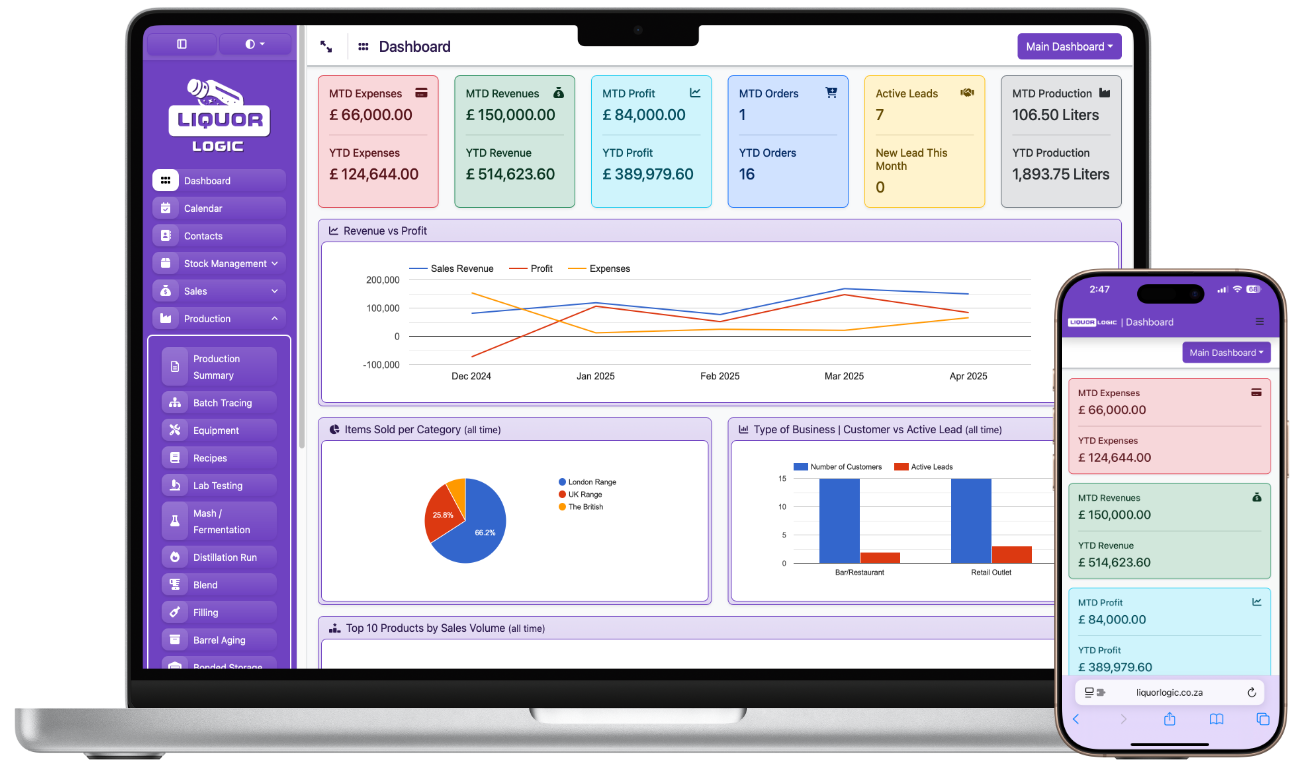
The most impactful technology shift in the craft alcohol sector has been the arrival of cloud-based, purpose-built production management platforms. These systems replace the fragmented combination of spreadsheets, notebooks, and disconnected apps with a unified digital environment covering the full production lifecycle—from raw material procurement through to finished goods dispatch.
Cloud-based platforms offer critical advantages over legacy on-premise systems. They're accessible from any device, anywhere—meaning a brewer on the production floor and an owner reviewing reports remotely are looking at the same live data. They update in real time as production events occur. And they scale with the business without requiring hardware investment or IT infrastructure. Liquor Logic is designed for exactly this purpose—a cloud-based, mobile-friendly platform that gives alcohol producers comprehensive operational visibility without the complexity or cost of enterprise ERP systems.
IoT and Real-Time Fermentation Monitoring
Internet of Things (IoT) technology—the connection of physical sensors and devices to digital networks—has arrived in the brewery and is transforming fermentation management. Remote sensor systems can now monitor fermentation vessel temperature, pressure, and gravity in real time, sending data continuously to a cloud dashboard accessible from any smartphone or computer.
The practical implications are significant. Brewers can monitor multiple fermentation vessels simultaneously without manual sampling. Temperature excursions trigger instant alerts rather than being discovered on the next physical check. Gravity curves allow brewers to track fermentation progress precisely and predict terminal gravity with accuracy—optimising the decision of when to move beer to conditioning. For distilleries, sensor technology is being applied to still monitoring, barrel warehouse temperature management, and cut point decision-making.
Data Analytics and Demand Forecasting
Every brewing operation generates substantial data: batch yields, ingredient costs, sales volumes by SKU, seasonal demand patterns, packaging efficiency rates. For most breweries, this data exists but isn't systematically analysed—it sits in spreadsheets and POS reports, consulted occasionally rather than driving operational decisions.
Modern brewery technology software platforms are changing this by making analytics accessible and actionable. Production efficiency trends can be monitored over time, making it easier to identify whether yield variances are random or systematic. Sales data can be analysed to surface demand seasonality, helping production teams schedule batches to meet demand peaks without building excess stock. Ingredient cost tracking helps recipe managers understand the true margin profile of each product.
Mobile-First Operations
Brewery operations don't happen at a desk. Brewers are on the floor, in the cellar, at the bright tank, on the loading dock. A management system that requires staff to walk to a desktop computer to log production data will be used inconsistently at best and ignored at worst. The move to mobile-first brewery management technology means platforms are now genuinely usable on phones and tablets in the production environment. Deliveries can be receipted at the loading bay. Batch progress can be logged from the fermentation cellar. Inventory adjustments can be made from the taproom storeroom. The data stays current because entering it is frictionless. Liquor Logic's mobile-friendly design reflects this principle throughout.
Product Traceability Technology
Product traceability—the ability to trace a finished product back to its specific ingredient sources, and forward from an ingredient lot to every batch that used it—is increasingly important for both regulatory compliance and customer trust. Technology advances range from lot-tracking within production management software (the foundation that most breweries need) to more sophisticated applications involving QR codes on packaging that link consumers directly to batch-specific production data and quality records.
For excise authorities, detailed traceability records demonstrate that production volumes are accurately reported. For retailers and distributors, they provide assurance of quality and authenticity. For consumers, they support the transparency and provenance story that drives brand loyalty in the craft sector.
Sustainability and Waste Reduction Technology
Sustainability has become a core concern for the alcohol industry—both as a genuine commitment and as an increasingly important factor in consumer purchasing decisions. Technology is playing a meaningful role in enabling more sustainable operations. Real-time water usage monitoring in breweries identifies waste and conservation opportunities that are invisible in aggregate monthly readings. Automated yield tracking identifies where raw materials are being lost in the production process—whether in the brewhouse, at fermentation, or during packaging—enabling targeted process improvements. Waste reporting built into production management software quantifies by-product volumes that can be redirected to agricultural or food uses rather than landfill.
How Independent Producers Can Compete with Technology
One of the most exciting aspects of the current alcohol technology landscape is that scale is no longer a prerequisite for operational sophistication. The technologies described above—cloud-based production management, IoT monitoring, mobile operations, data analytics—are accessible to independent craft breweries at a price point that was simply not available five years ago.
A 10-barrel craft brewery can have real-time inventory visibility, automated compliance reporting, and mobile batch management for a monthly subscription cost that's a fraction of the labour it replaces. The operational disciplines that once gave large-scale producers an efficiency advantage are now democratised. This creates an opportunity for forward-thinking independent producers to operate with the efficiency of a large brewery while maintaining the agility, creativity, and brand authenticity that define craft. The breweries that embrace craft beer technology are building sustainable competitive advantages that are difficult for less-organised competitors to match.
Why Liquor Logic Is at the Forefront of Alcohol Technology
Liquor Logic is built on the belief that the best technology for the alcohol industry combines operational depth with genuine usability—a platform that brewers actually use, that fits naturally into the rhythms of production, and that delivers insight without demanding a data analyst to interpret it. Key features that make Liquor Logic a leader in brewery management technology include:
- Cloud-Based Inventory and Production Management: Real-time visibility across raw materials, work-in-progress, and finished goods from any device.
- Recipe Development and Batch Tracking: Scale recipes accurately and monitor every production stage with complete traceability.
- Multi-Location Operations: Manage stock and production data across taprooms, facilities, and warehouses with consolidated reporting.
- Automated Compliance Reporting: Generate excise returns and production records directly from operational data—no manual compilation required.
- Mobile-First Design: Purpose-built for use on the production floor, in the cellar, and anywhere your team operates.
Get Started with Liquor Logic
If you're ready to move beyond spreadsheets and disconnected systems, Liquor Logic is ready to help. Join the growing community of craft and independent alcohol producers who are using alcohol technology to brew smarter, manage tighter, and build stronger businesses.