Beer Supply Chain Management: A Practical Guide for Breweries
Master beer supply chain management to build a more resilient, efficient brewing operation—from ingredient sourcing and production planning to finished goods distribution. Discover how Liquor Logic gives breweries end-to-end visibility across the entire supply chain, so you can respond to challenges before they become crises.
What Is Beer Supply Chain Management?
Beer supply chain management encompasses all the processes involved in sourcing ingredients, producing beer, managing inventory, and distributing finished product to customers. It's an end-to-end discipline that connects your suppliers, your production facility, your storage and distribution infrastructure, and your sales channels into one coordinated system.
Unlike generic supply chain management, beer supply chains have unique characteristics that add complexity. Hops, yeast, and certain malts have limited shelf lives and require specific storage conditions. Hop contracts are often placed 12 to 18 months in advance. Seasonal demand creates production planning challenges. Alcohol production is heavily regulated, requiring detailed supply chain records for excise authorities and traceability requirements. And navigating distribution networks—whether through the three-tier system, direct to retail, or direct to consumer—adds further operational layers. For craft breweries and microbreweries, a well-managed brewery supply chain is a genuine competitive advantage.
The Key Stages of the Beer Supply Chain
Understanding the full scope of your supply chain is the first step to managing it effectively. Each stage presents its own challenges and opportunities for optimisation.
Procurement and Supplier Management
The supply chain begins with procurement—sourcing the raw materials your recipes require. For most breweries, the primary inputs are malt, hops, yeast, water treatment chemicals, and packaging materials. Effective procurement involves more than placing orders:
- Supplier qualification and diversification: Building relationships with reliable suppliers—and maintaining backup suppliers for critical inputs—is essential for supply chain resilience. A single-source dependency on a specific hop variety is a significant supply risk.
- Forward contracting: Hops are typically contracted in advance through annual or multi-year agreements. Breweries that don't forward-contract their key varieties risk supply shortages or premium spot pricing when demand is high.
- Lead time management: Different ingredients have very different lead times. Malt from a local maltster may arrive in days; custom-printed packaging cans often require 8 to 12 weeks. Understanding and planning around these lead times is critical for uninterrupted production.
- Cost management: Ingredient costs fluctuate. Effective procurement balances cost certainty through forward contracts against flexibility for seasonal and experimental batches.
Inbound Logistics and Raw Material Management
Once orders are placed, inbound logistics covers the physical movement of ingredients from supplier to your brewery, their receipt and inspection, and their storage prior to production use. Good inbound logistics practice includes:
- Receiving inspections: Verify that deliveries match purchase orders in quantity and quality. Check for damage, confirm batch and lot numbers, and verify expiry dates on perishable ingredients.
- Proper storage: Hops should be stored cold and sealed. Yeast requires refrigeration. Malt should be kept cool and dry. Non-compliant storage conditions accelerate degradation and compromise batch quality.
- Lot tracking: Record the lot number of every ingredient received against your inventory. This underpins beer supply chain traceability and is essential for managing quality investigations and potential recalls.
- FEFO rotation: First Expired, First Out rotation ensures perishable ingredients are consumed before they degrade, minimising waste.
Production Planning and Brewing
Production planning sits at the intersection of supply and demand. The production plan determines what you brew, when you brew it, and in what volumes—driven by sales forecasts, current inventory levels, available capacity, and raw materials on hand. Effective production planning involves:
- Capacity planning: Knowing your facility's brewing capacity—brew lengths, tank volumes, fermentation durations, and packaging capacity—and scheduling batches to maximise throughput without creating bottlenecks.
- Materials Requirements Planning (MRP): Calculating the raw material quantities needed to meet the production schedule and ensuring purchase orders are placed in time to meet production start dates.
- Yield management: Tracking actual yield against expected yield for every batch. Consistent yield shortfalls—in the brewhouse, in fermentation, or at packaging—indicate process inefficiencies that need to be addressed.
Finished Goods Inventory Management
Once beer is packaged, it enters finished goods inventory—the stock available to sell. Managing finished goods effectively means balancing availability against carrying costs and shelf life constraints. Overstocking ties up capital and, for beers with limited shelf life, creates spoilage risk. Understocking means missed sales and disappointed customers.
- SKU rationalisation: More SKUs means more complexity. Regular reviews help focus production resources on the products that generate the most value and prevent slow-moving inventory from accumulating.
- Shelf life monitoring: Implement FIFO rotation in your warehouse and across your distribution network to ensure older stock reaches the market first.
- Demand forecasting: Historical sales data, seasonal patterns, event calendars, and market trends all inform forecast accuracy. Better forecasts lead to better production plans and less inventory imbalance.
Distribution and Outbound Logistics
Getting finished product from your warehouse to your customers is the final stage of the beer supply chain. Whether that's direct-to-consumer via your taproom, wholesale distribution, retail delivery, or export, distribution management involves order fulfilment accuracy, cold chain compliance for fresh and unpasteurised beers, returns management, and key account servicing. For breweries distributing through wholesalers, maintaining accurate knowledge of stock levels in the distributor's warehouse—not just your own—is important for managing reorder timing and promotional planning.
Common Beer Supply Chain Challenges
Even well-organised breweries face supply chain disruptions. These are the most frequent challenges producers encounter in craft beer logistics and supply chain management:
- Ingredient shortages and price volatility: The hop market is subject to short supply events, with certain varieties selling out quickly. Breweries without forward contracts or alternative recipe formulations are exposed to both supply and price risk.
- Demand unpredictability: Viral social media moments, seasonal shifts, and competitor activity can cause demand to spike or collapse quickly—challenging for breweries with long production lead times.
- Packaging lead times: Custom-printed cans require significant lead time and minimum order quantities that can tie up capital and create inventory risk if sales projections are missed.
- Distribution network complexity: Managing relationships with multiple wholesale distributors across different territories, each with their own ordering systems, performance expectations, and compliance requirements, is a major operational undertaking.
- Data fragmentation: Many breweries operate with disconnected systems for procurement, production, inventory, and sales—making it difficult to maintain a coherent view of the entire supply chain.
Best Practices for Beer Supply Chain Resilience
Building a resilient, efficient brewery supply chain requires both strategic planning and the right operational tools. These best practices are adopted by the most efficient craft breweries worldwide:
- Diversify your supplier base: Don't rely on a single supplier for any critical ingredient. Qualifying backup suppliers before you need them is the best insurance against disruption.
- Forward contract strategically: Use hop contracts and advance malt orders to lock in supply and pricing for core recipes, while maintaining flexibility for seasonal and experimental batches.
- Invest in demand forecasting: Even simple demand models based on historical sales data and known seasonality will significantly improve your production planning over intuition alone.
- Integrate your systems: Disconnected tools create blind spots. A unified production and inventory management platform gives you the visibility needed to manage your supply chain proactively rather than reactively.
- Review supply chain KPIs regularly: Track metrics including ingredient waste percentage, on-time delivery from suppliers, finished goods availability by SKU, and order fulfilment accuracy. Consistent KPI reviews drive continuous improvement.
How Liquor Logic Optimises Your Beer Supply Chain
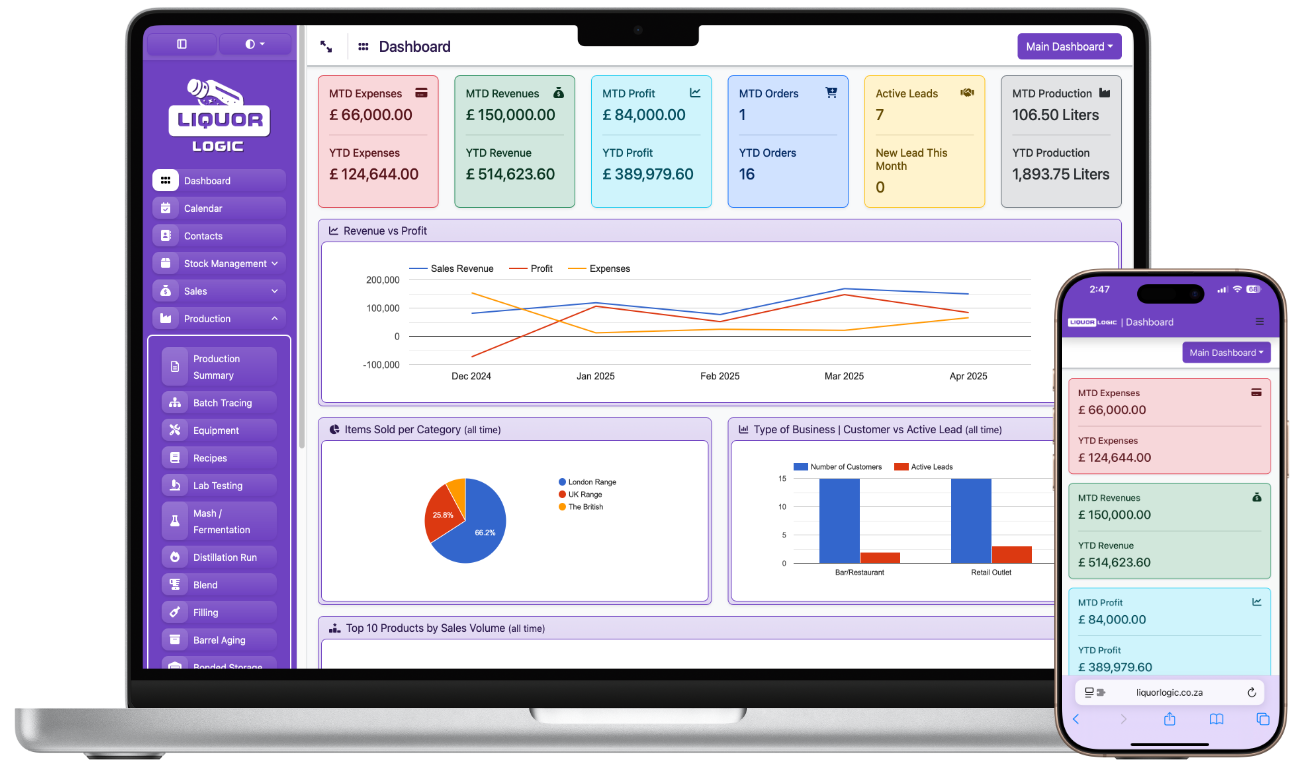
Liquor Logic provides breweries with an integrated platform that brings visibility, control, and intelligence to every stage of the beer supply chain. By connecting procurement, production, inventory, and sales data in a single cloud-based system, Liquor Logic eliminates the data fragmentation that undermines supply chain performance.
Key capabilities include real-time raw material inventory tracking with automated reorder alerts, production planning tools that align batch scheduling with demand forecasts, complete batch traceability from ingredient lot to finished product, multi-location inventory management across taprooms and warehouses, and integrated sales and distribution tracking. With Liquor Logic, brewery owners and operations managers have the information they need to make confident, timely decisions—whether that's placing a hop order, scheduling the next batch run, or managing a stock transfer between locations.
Get Started with Liquor Logic
Liquor Logic helps breweries of every size build more efficient, more resilient supply chains—from ingredient procurement to finished goods distribution. Our cloud-based platform gives you real-time visibility across your entire operation, so you can respond to supply chain challenges before they become crises.