Brewery Stock Control: The Complete Guide to Stocktakes and Inventory Accuracy
Master brewery inventory management to eliminate stockouts, reduce waste, and keep production running without interruption. Discover how Liquor Logic's cloud-based platform gives craft breweries and microbreweries real-time control over every ingredient, batch, and finished product in their operation.
This guide focuses on the hands-on discipline of stock control: counts, rotation, thresholds, and accuracy. For the strategic overview of systems and planning, read our companion guide to inventory management for breweries.
What Is Brewery Inventory?
Brewery inventory refers to all the physical stock a brewery owns and manages as part of its production and sales operation. This spans several distinct categories, each with its own characteristics, storage requirements, and management challenges. Understanding what's included in your brewery's inventory—and how each category behaves—is the foundation of effective stock management.
Without a unified approach to brewery stock management, even experienced operators find themselves firefighting: scrambling to cover ingredient shortages, losing track of batch progress, or discovering expired materials during a production run. Questions like "How do I manage brewery inventory effectively?" are among the most common we hear from brewmasters and operations managers. The answer lies in treating inventory not as a counting exercise, but as a connected, real-time view of your entire operation.
Types of Brewery Inventory
Effective brewery inventory tracking requires a clear understanding of the different stock categories and what makes each one challenging to manage.
Raw Materials
Raw materials are the inputs to the brewing process—everything that goes into making your beer. For a typical brewery, this includes:
- Malt and grains: Base malts (pale malt, pilsner malt, lager malt), specialty malts (crystal, roasted, wheat), and adjunct grains (oats, rice, corn), each with different storage requirements and shelf lives.
- Hops: Pellet hops and whole hops in a range of varieties, often contracted in advance and stored cold to preserve alpha acid content and freshness.
- Yeast: Liquid or dried brewing yeast, stored under refrigeration with limited viability windows that must be actively monitored.
- Water treatment chemicals: Calcium sulphate, calcium chloride, lactic acid, and other additions used to adjust water chemistry for specific beer styles.
- Adjuncts and specialty additions: Fruit, spices, coffee, lactose, honey, and other ingredients used in seasonal and specialty releases.
- Finings and processing aids: Irish moss, whirlfloc, gelatin, and similar clarifying agents consumed at various stages of production.
Work-in-Progress (WIP)
Work-in-progress inventory covers beer at every stage of the production process that isn't yet packaged and ready to sell—wort in the kettle, green beer in primary fermentation, conditioning beer in bright tanks, and beer awaiting filtration or carbonation adjustment. WIP is the most complex category to track because it's constantly in motion, changing in character through fermentation and conditioning. Knowing exactly how much beer is in each production stage, and when it will be ready, is critical for accurate sales forecasting and production scheduling.
Finished Goods
Finished goods are your packaged, saleable products—kegs, cans, bottles, and crowlers ready to go to market. This is the category most directly linked to revenue, and the one where stockouts and overstock are most immediately felt by the business. Finished goods brewery management involves tracking stock by SKU and packaging format, monitoring sell-through rates, managing allocation across sales channels, and ensuring FIFO rotation to minimise the risk of selling beer past its optimal drinking window.
Packaging Materials
Packaging materials—cans, bottles, crowns, keg valves, labels, carriers, and boxes—are consumed in the packaging process and need to be managed as carefully as ingredients. Running out of cans on a packaging day is a costly disruption. Over-ordering custom-printed packaging ties up capital unnecessarily. Packaging materials often have their own minimum order quantities and lead times, which need to be factored into procurement planning alongside ingredient orders.
Why Brewery Inventory Management Is Challenging
Breweries face a unique combination of inventory management challenges that generic stock systems are not equipped to handle. Understanding these challenges is the first step to building a more resilient operation.
- Perishability: More than almost any other manufacturing sector, brewery inventory is time-sensitive. Hops degrade over time even when refrigerated. Yeast has a limited viable lifespan. Finished beer, particularly unpasteurised craft beer, has a defined freshness window that affects marketability. Managing perishable inventory at scale requires systematic processes and real-time visibility that manual methods struggle to provide.
- The Batch Production Model: Breweries produce in batches—discrete quantities made to a specific recipe over a defined production cycle. Raw materials spike downwards when a batch is brewed, WIP builds and then converts to finished goods on a batch-by-batch basis. Tracking inventory through this cycle requires a system that understands the batch production model.
- Recipe Complexity and Variation: Each recipe uses a unique combination of ingredients in specific quantities. Scaling recipes up or down, adapting for seasonal variations, or developing new products all change the ingredient demand picture. Manually tracking the inventory implications of recipe decisions is error-prone and time-consuming.
- Multi-Location Operations: Many breweries operate across multiple physical locations—a production facility, one or more taprooms, an offsite warehouse, and potentially distribution points. Maintaining accurate, consolidated inventory visibility across all locations is a significant challenge without the right tools.
- Compliance and Traceability: Alcohol production requires meticulous record-keeping for regulatory compliance. Tax authorities need production volumes. Quality investigations require ingredient traceability. Auditors expect batch records to link finished products back to specific ingredient lots. Manual records are a compliance risk; an integrated inventory system maintains these records automatically.
Best Practices for Brewery Inventory Management
These are the practices adopted by the most efficient craft breweries worldwide—and the foundation of effective brewery inventory management at any scale:
- Conduct Regular Physical Counts: Even with the best software, physical inventory counts are essential. Breakage, spillage, measurement variance, and data entry errors mean system records and physical reality diverge over time. Cycle counting—counting a subset of items on a rotating schedule—is more practical than periodic full shutdowns.
- Implement FIFO and FEFO Rotation: First In, First Out (FIFO) ensures older stock is consumed before newer stock. First Expired, First Out (FEFO) prioritises consumption based on expiry date—essential for perishable ingredients. Label all incoming stock clearly and organise storage so older stock is always most accessible.
- Set Minimum Stock Thresholds: For every raw material and key packaging component, define a minimum stock threshold—the level at which a purchase order should be triggered. Set this threshold to account for supplier lead time plus a safety buffer.
- Track Ingredient Lot Numbers: Recording the lot number of every ingredient delivery creates the traceability chain required for quality investigations and regulatory compliance. If a specific ingredient lot causes quality issues, lot tracking allows you to identify exactly which batches are affected.
- Review Slow-Moving and Obsolete Stock Regularly: Not all inventory moves at the same rate. Regular reviews of slow-moving and obsolete stock prevent specialty ingredients from quietly expiring and inform more disciplined purchasing decisions.
- Integrate Inventory with Production Planning: The most effective approach is a closed-loop system where your production plan drives raw material requirements, inventory records automatically update as materials are consumed, and finished goods records reflect actual packaging output. This integration eliminates manual reconciliation and dramatically improves data accuracy.
Common Brewery Inventory Mistakes to Avoid
Many breweries fall into the same patterns that undermine their brewery stock management effectiveness. Here are the most costly mistakes to watch out for:
- Relying on memory: "I know roughly how much Citra we have" is not inventory management. Even experienced brewers misjudge stock levels under production pressure.
- Ignoring packaging materials: Many breweries track ingredients carefully but treat packaging components as an afterthought—until they run out of can ends on a busy packaging day.
- Infrequent counts: Counting inventory once a quarter is not sufficient. Stock discrepancies compound over time and become harder to investigate the longer they're left.
- No expiry date tracking: Without a systematic record of expiry dates, old ingredients get buried behind new deliveries and spoilage goes unnoticed until it's too late.
- Disconnected systems: Managing inventory in one system, production in another, and sales in a third creates data silos that prevent you from getting a coherent picture of your operation—and the information you need to make good decisions.
How Liquor Logic Transforms Brewery Inventory Management
For most breweries beyond a very small scale, effective craft brewery inventory management requires dedicated software. Spreadsheets have fundamental limitations: they don't update automatically, they don't support real-time multi-user access, they can't generate automated alerts, and they're not connected to your production or sales data. Dedicated brewery inventory software like Liquor Logic addresses all of these limitations.
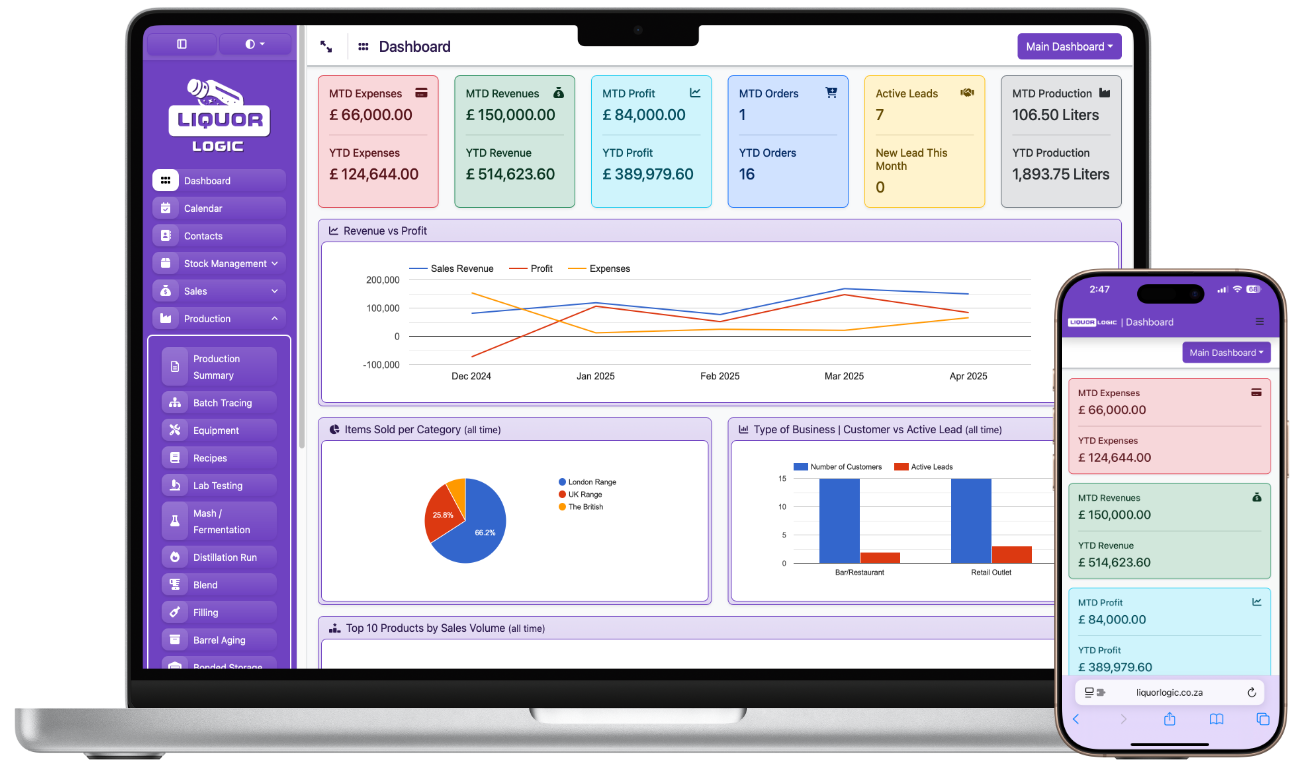
Liquor Logic provides real-time inventory dashboards that show current stock levels for every raw material, WIP batch, and finished goods SKU—accessible from any device. Automated consumption tracking deducts raw material usage as batches are created. Reorder alerts notify procurement when stock drops below defined thresholds. Lot tracking and traceability links every finished product to the specific ingredient lots used in its production. Multi-location management handles real-time stock transfers and consolidated reporting across all sites. And compliance-ready records maintain the production and inventory documentation required for excise reporting and regulatory audits—automatically.
Get Started with Liquor Logic
Liquor Logic gives breweries complete control over their inventory—from the first sack of malt through to the last keg dispatched. Our cloud-based platform integrates brewery inventory management with production planning, batch management, and sales operations to give you a real-time, end-to-end view of your entire operation. Whether you're a microbrewery managing a handful of SKUs or a regional craft brewery running multiple sites, Liquor Logic scales to your needs.